Dealing with this right now? See our storm damage cleanup service, and we respond fast across Secret Ravine. Or call +1 (201) 277-9344 any time — we answer 24/7.
Water finds whatever path you've built for it, on purpose or by accident. A downspout dumping six inches from the foundation, a yard that slopes toward the house instead of away from it, a gutter running a few degrees flat instead of pitched toward the outlet: none of these look like problems on a dry August afternoon. By January, during a multi-day storm cycle, they're the reason water is sitting against a slab edge or wicking up into a baseboard.
This checklist covers the drainage system most homeowners never think about until it fails: gutters, downspouts, grading, and the yard's own capacity to move water away from the house rather than toward it. It's aimed at getting ahead of the season, not reacting to it.
Gutters: sizing, slope, and the oak-leaf problem
A lot of older Placer County neighborhoods, including streets near Secret Ravine, sit under mature oak canopy that drops leaves steadily through fall and into winter, well past when most people stop checking their gutters. A gutter that's fine in October can be half-blocked by December.
Beyond clearing debris, check that gutters still pitch toward their downspout outlets. Fasteners loosen over years of thermal expansion and contraction, and a gutter that's gone flat or reverse-pitched in one section will pool water and overflow right at that spot, usually straight down an exterior wall.
Downspouts: get water at least four to six feet from the foundation
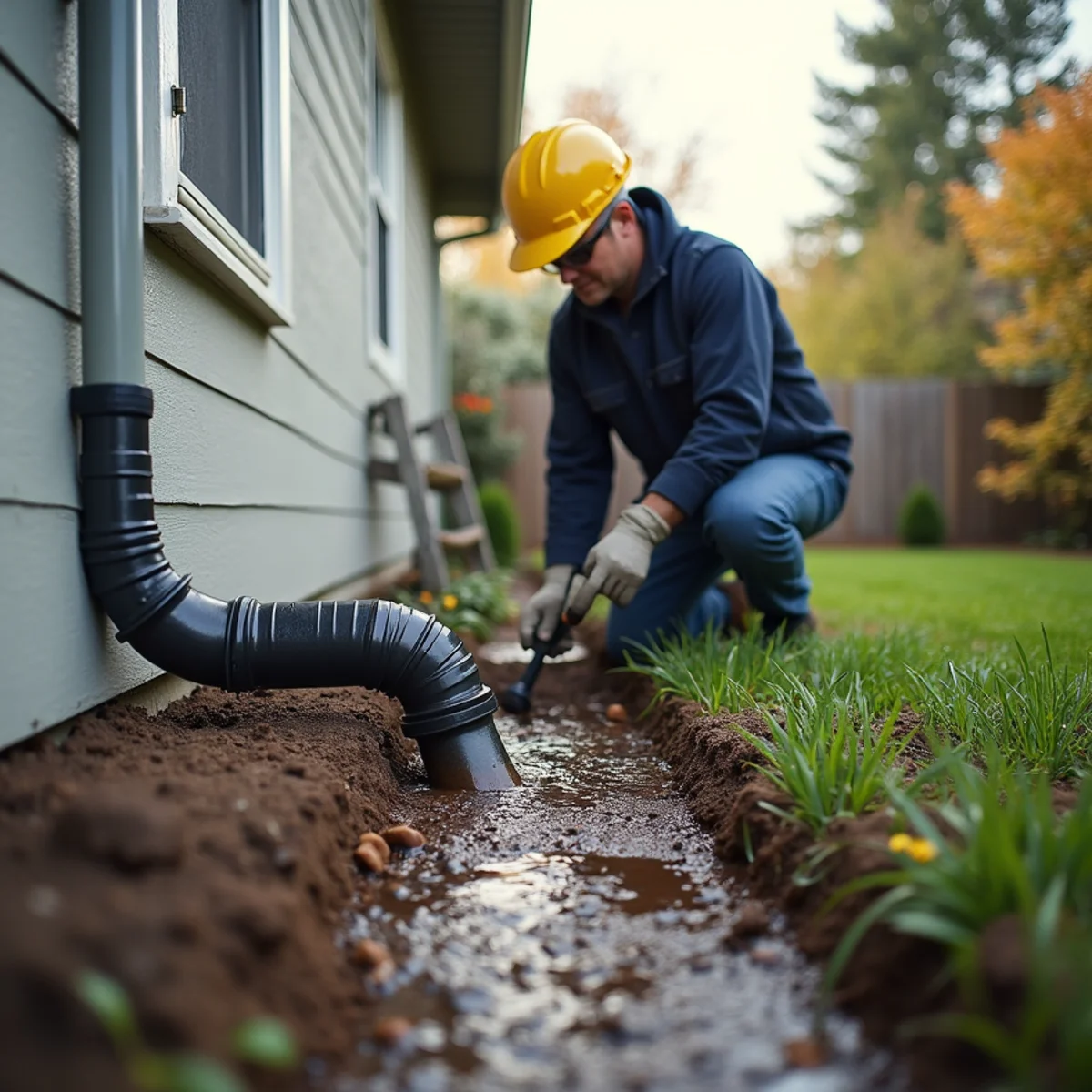
The single most common drainage mistake we see is a downspout that discharges water within a foot or two of the foundation. Over a wet season that adds up to hundreds of gallons soaking into the soil right where you least want saturation, against the slab edge or a crawl space wall.
- Add or extend downspout extensions so water discharges at least four to six feet from the foundation
- Check that splash blocks or extensions haven't shifted out of place or been knocked loose
- Confirm underground downspout drain lines, if you have them, aren't clogged or collapsed at a joint
Grading and swales around the slab
Most Placer County homes are built slab-on-grade, which means the soil grade around the perimeter does a lot of the work that a basement wall or crawl space would otherwise absorb. Over years, mulch, new landscaping, or settling can flatten or reverse that slope without anyone noticing.
Walk the perimeter after a light rain and look for water pooling against the foundation rather than running past it. A slope of roughly six inches of drop over the first ten feet from the house is generally enough to keep water moving away rather than settling in place.
French drains and dry wells for hillside and creek-adjacent lots
Homes on hillside lots or near the Secret Ravine watershed often deal with runoff volume that grading alone can't handle, especially during an atmospheric river event when the ground upslope is already saturated. A French drain intercepts that water before it reaches the foundation and redirects it to a dry well or approved discharge point.
This isn't a weekend DIY fix if your lot has real grade or a documented history of yard flooding. Get a drainage contractor to assess slope and soil type before digging, since an undersized or badly routed French drain can concentrate water in a new problem spot instead of solving the original one.
Driveways, patios, and catch basins
Hardscape sheds water fast, which is exactly the problem when it's pitched toward the house instead of the street or a yard drain. Check that any catch basins in driveways or low patio corners are clear of debris and that their outlet pipes aren't blocked, since a clogged catch basin behaves like no catch basin at all during a heavy storm.
Solid concrete patios poured close to the house without a drain of any kind are a common culprit in newer builds. If you're planning a patio replacement, permeable pavers or an added trench drain along the house-side edge cost more upfront but stop a slab of hardscape from acting like a ramp that funnels rainwater straight at the foundation.
Window wells and other below-grade entry points
Not every Placer County property is pure slab-on-grade; some older homes and daylight-lot properties have window wells or below-grade entries that create their own drainage problem, separate from the foundation perimeter. A window well without a functioning drain at its base fills like a bathtub during a multi-day storm and pushes water directly against window seals that were never built to hold it back.
If you have a window well, check that its drain isn't silted shut and that any cover is directing runoff away rather than funneling roof water straight into it.
A recent job: when grading alone wasn't the fix
We were called to a home off a cul-de-sac near Rocklin's Secret Ravine corridor where the owner had already regraded the side yard twice, and water still tracked back toward a bedroom wall every storm season. The actual source turned out to be a downspout draining into an underground pipe that had crushed at a joint years earlier, invisible from the surface, quietly discharging water six feet underground instead of at the yard's edge where it was designed to exit.
We extracted the wet baseboard and flooring, dried the wall cavity over four days with monitored dehumidification, and flagged the collapsed line so the homeowner's landscaper could dig it up and replace it before the next season. Grading fixes what you can see. A camera inspection of buried drain lines catches what you can't.
What our crews check that a homeowner walk-through misses
The mistake we see most with drainage complaints is stopping the investigation at the first visible cause. A homeowner notices an overflowing gutter, fixes that, and assumes the water intrusion is solved, when the gutter overflow and the water reaching the foundation were two separate, only loosely related problems. We always trace water to its actual entry point before calling a fix complete, because the visible cause and the real cause aren't always the same thing. We've traced yard flooding that looked like a grading problem back to a collapsed downspout line more than once in a single season, each one initially blamed on the wrong cause.
The honest tradeoff on drainage work is that a camera inspection of underground downspout lines costs more upfront than just regrading and hoping, but regrading alone can't fix a crushed or disconnected pipe running six feet underground. If a drainage problem keeps coming back after a fix that should have worked, that's usually the sign something buried is the actual source, not a reason to regrade a third time. Budget a camera inspection the way you'd budget a roof inspection, a periodic check rather than a reaction to a problem that's already recurring.
- Trace water to its actual entry point before calling a drainage fix complete
- A recurring problem after a fix that 'should have worked' usually means a buried pipe issue, not a regrading problem
- A camera inspection typically costs far less than the flooring, drywall, and paint a hidden pipe failure eventually requires once it surfaces indoors
Off-season drainage maintenance that pays off by January
Most of this checklist is about getting ready right before the season starts, but a few drainage components benefit from attention on a longer, off-season cycle, the kind of maintenance that's easy to put off because nothing looks obviously wrong in July.
Doing this work in the dry months also means you're not troubleshooting a clogged catch basin or a silted French drain inlet during an actual storm, when access is harder and the fix takes longer under time pressure.
- 1Late spring: have underground downspout lines camera-inspected every few years, especially on homes over 20 years old, since a crushed joint gives no warning above ground
- 2Summer: jet or snake any French drain lines to clear silt before it compacts into a harder blockage
- 3Late summer: reassess grading after any landscaping, mulch refresh, or hardscape work completed that year, since these routinely flatten slopes without anyone intending it
- 4Early fall: pressure-wash catch basin grates and outlet pipes before leaf drop adds a fresh layer of debris on top of anything already settled
- 5Year-round: keep a simple log of which gutters, downspouts, and drains got attention and when, so a repeat problem is obvious instead of relying on memory
A pre-season walk-through checklist
Run through this list once in early fall, then again after the first real storm to confirm everything held.
- 1Clean and check the pitch of every gutter run
- 2Extend all downspouts at least four to six feet from the foundation
- 3Walk the foundation perimeter after a light rain and look for standing water
- 4Clear catch basins and confirm their outlet pipes are open
- 5Check French drains or dry wells for silt buildup at the inlet
- 6Photograph problem spots so you can track whether fixes actually worked
Frequently asked questions
If water is pooling against the foundation for more than a few hours after rain stops, or you've had water intrusion at the base of a wall before, it's worth a drainage assessment. Minor pooling in the middle of the yard that drains within an hour is usually not urgent.
Garage floors sit at grade in most Placer County homes, so a low spot in the driveway apron or a reverse-sloped section right at the garage door can let water in even with functioning gutters. We can trace the actual path the water took so you're not guessing at the fix.
Yes. We extract standing water, dry affected flooring, drywall, and baseboards to IICRC S500 standards, and document everything for your insurance claim. We also flag the drainage issue so it gets fixed before the next storm causes a repeat loss.
They reduce the frequency of clogs but don't eliminate maintenance entirely. Guards still need periodic clearing when fine debris or seed pods build up on top of the screen, and a guard installed over a gutter that's already pitched wrong just clogs a wrong-pitched gutter more slowly. Check pitch and slope first, then decide if guards are worth adding.