Dealing with this right now? See our commercial water damage restoration service, and we respond fast across South Roseville. Or call +1 (201) 277-9344 any time — we answer 24/7.
A residential water loss costs a homeowner money and stress. A retail water loss costs a store its sales floor, and every hour it stays closed is revenue that doesn't come back. Around Westfield Galleria at Roseville and the Fountains at Roseville, we've responded to sprinkler discharges, restroom backups, and roof leaks that turned a Saturday morning into a closed storefront, and the difference between a one-day closure and a week-long one almost always comes down to how the first thirty minutes were handled.
This is a practical response plan built for retail managers and multi-tenant property staff: what to do immediately, who else needs a call, and how to protect inventory and get the doors back open as fast as the drying process allows.
The first 30 minutes: what a store manager should do
Speed matters more in retail than almost any other property type, because merchandise, fixtures, and flooring are all exposed and often close to the source.
- 1Identify and stop the source if it's safely reachable: a shutoff valve, a fixture, an overhead line
- 2Move portable inventory, especially anything on lower shelving or the floor, away from the wet area
- 3Call mall or center property management immediately, they often need to notify other affected tenants or shut off a shared line
- 4Call us for extraction and drying, don't wait to see if it dries on its own overnight
- 5Photograph the affected area, the source if visible, and any damaged inventory before anything is moved or discarded
Multi-tenant complications: who else needs to know
A loss in a space the size of Westfield Galleria at Roseville, roughly 1.3 million square feet, rarely stays contained to one storefront. Shared plumbing chases, common-area restrooms, and food court lines run behind multiple units, and water that starts in a stockroom can travel along a shared wall into the neighboring tenant's space before anyone notices.
Property management needs a call as soon as the source is identified, both to shut off shared systems and because their maintenance team may already know about a related issue elsewhere in the building. If the loss touches a common area, mall management's own insurance and restoration contacts may also need to coordinate directly with ours. Food court tenants have an added wrinkle: grease trap backups and shared HVAC condensate lines can look like a plumbing leak at first glance but require different contamination handling entirely, so identifying the actual source early changes how we respond.
Protecting inventory, fixtures, and POS equipment
Retail losses put more at risk per square foot than almost any other commercial space: merchandise, display fixtures, point-of-sale terminals, and back-office equipment often sit directly on or near the floor. Elevate what you can onto pallets or higher shelving immediately, and unplug and relocate electronics rather than assuming a wet floor won't reach them.
Document damaged inventory before discarding anything. Retailers often need itemized loss records for both their own insurance claim and, in a multi-tenant building, for any liability claim against the property if the source was a building system rather than something inside the leased space. Stockrooms deserve the same urgency as the sales floor; back-of-house shelving often sits closer to the original source and gets checked last.
Category and contamination concerns in retail spaces
Not every retail water loss is the same category. A roof leak or overhead sprinkler discharge is typically Category 1, clean water, if caught quickly. A restroom or break room backup is a different situation entirely, Category 3, and requires contamination protocols, not just drying, because it poses a real health risk to staff and customers if handled like a routine spill.
We assess category on arrival and adjust the response accordingly: personal protective equipment, contaminated material removal, and antimicrobial treatment for Category 3 losses, versus straightforward extraction and drying for Category 1. Misjudging the category is the single most common mistake we see when a store tries to handle a spill in-house with a mop and a wet vac before calling anyone.
Documentation that speeds up the insurance and lease process
Commercial claims move faster with more documentation, not less. We provide a written scope of work, moisture logs, and drying progress reports that satisfy both your business insurance carrier and, if the lease requires it, the property owner or mall management's own records for the incident.
- Photos and video of the affected area before any cleanup begins
- A written incident timeline: when discovered, when reported, when response arrived
- Itemized list of damaged inventory, fixtures, and equipment with approximate values
- Daily moisture readings throughout the drying process
Getting back open: drying timeline vs. retail urgency
Structural drying for a retail space typically runs three to five days, similar to residential work, but retail tenants often want partial reopening sooner. We can section off and dry the affected area with containment barriers while the rest of the store stays open, when the layout allows it, so you're not losing full sales floor access for the entire drying period. We coordinate the containment plan with your visual merchandising team so barriers don't block sightlines to unaffected merchandise any longer than necessary.
A recent job: a sprinkler head and a Saturday morning
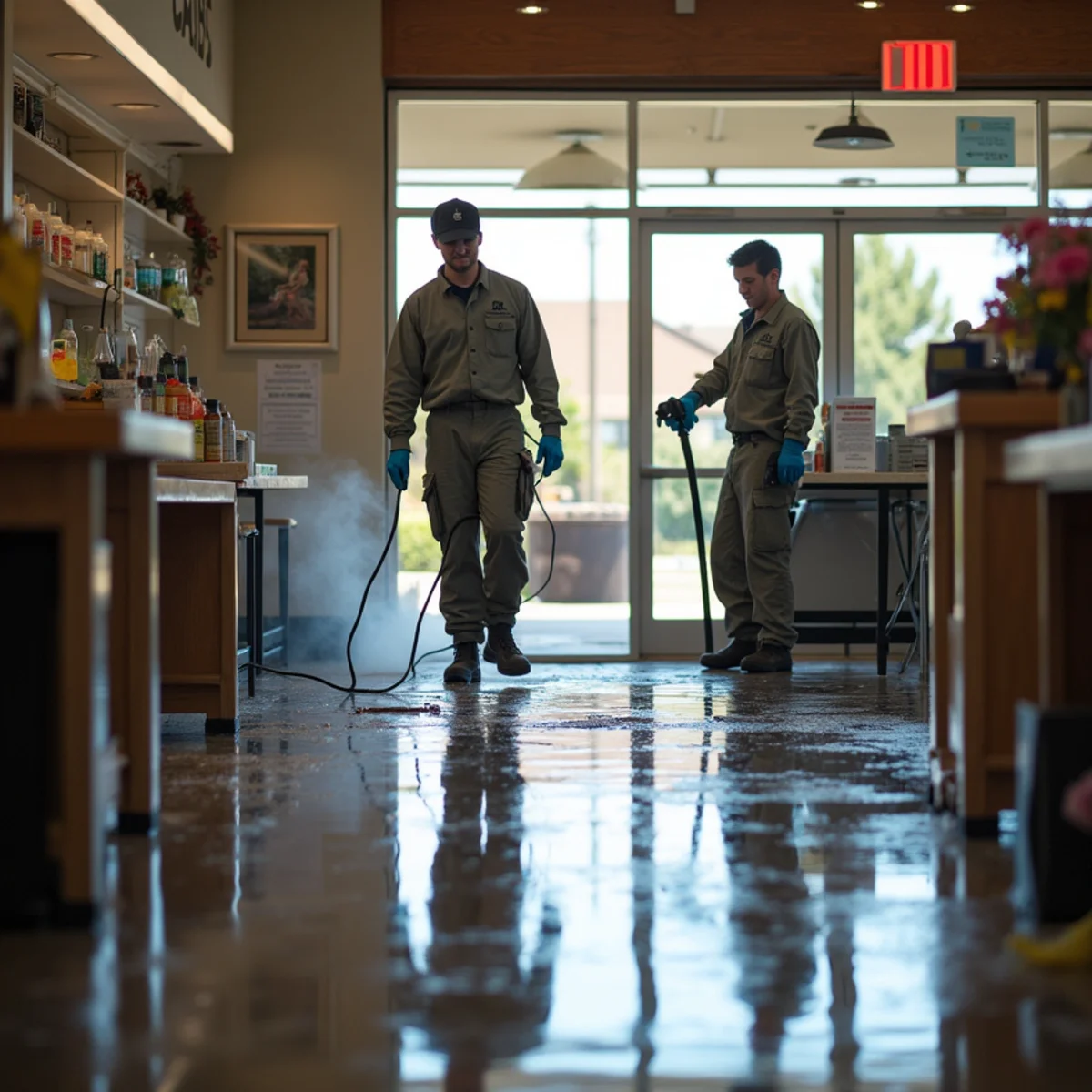
A retail tenant near the Galleria corridor had a sprinkler head fail overnight, and by the time the manager opened at 10 a.m., about 400 square feet of sales floor carpet tile was saturated and water had reached the base of two display walls. Because the manager called us and property management within the same ten minutes, we had extraction underway before noon and had the affected sprinkler zone shut off with facilities' help, preventing a second discharge.
We contained the wet section with barriers, kept the rest of the floor open for business, and completed structural drying in four days. The store lost roughly a quarter of its floor space for less than a week instead of closing entirely, largely because the response started within the hour rather than after a delayed morning discovery.
The mistake that turns a one-day closure into a week
The mistake that turns a one-day retail closure into a week-long one is reopening on appearance alone. A sales floor can look and feel dry to a manager checking at closing time while the pad beneath the carpet tile, or the subfloor under sheet vinyl, is still holding water that will show up as odor, discoloration, or a soft spot days later, usually after the store has already reopened and restocked the area. We always confirm moisture readings before clearing a section for reopening, not just a visual and a hand check. We'd rather run one more moisture pass than have a customer notice a smell two weeks later.
There's a real tradeoff in retail between speed and thoroughness that residential jobs don't usually face. A homeowner can live with a dehumidifier running in a closed-off room for five days; a retail tenant is losing sales floor every hour a section stays roped off. We manage that by sectioning containment as tightly as the damage allows and running more aggressive drying equipment in that smaller footprint, rather than closing off more square footage than the actual wet area requires. That containment footprint gets adjusted daily as readings come in, not fixed once at the start and left alone.
- Confirm moisture readings before clearing any section to reopen, not just a visual or touch check
- Tight containment around only the actual wet footprint keeps more of the floor open during drying
Calculating the real cost of downtime, and what shortens it
Retail managers often ask us to estimate closure time before we've even started extraction, which is a fair question since lost sales usually dwarf the direct cost of the repair itself. The honest answer is that closure time depends less on the size of the affected area than on how much of the store's structure the water actually reached; carpet tile alone dries faster than carpet tile over a saturated slab with wicking into a stud wall behind a fixture.
A few factors consistently separate a fast reopening from a slow one, and most of them are decided in the first hour, before drying equipment ever gets plugged in.
- How quickly the source was stopped: every extra hour of active water expands the wet footprint that needs drying
- Whether affected fixtures and shelving were elevated immediately, versus sitting in standing water absorbing moisture for hours
- Flooring type: sealed concrete and vinyl plank dry faster than carpet tile over a slab, which dries faster than carpet over a wood subfloor
- Whether containment can isolate the wet section without closing adjacent, unaffected sales floor
- How fast property management authorizes access to shared chases or shutoffs when the source is a building system
- Whether the store already had a documented incident-response plan on file, since decisions get made faster when no one's improvising the process for the first time
Frequently asked questions
We stage from our Vernon Street base and aim for a 60-minute arrival across Roseville, 24/7, including retail and commercial spaces near Westfield Galleria at Roseville and the Fountains. Call as soon as the source is stopped, don't wait for a slower business hours window.
It depends on the source and your lease terms. If the failure originated in a shared building system, the property owner's insurance is typically involved; if it originated inside your leased space, your own commercial policy usually leads. We document the source clearly so that determination isn't left to guesswork.
Often yes. Depending on the extent of the damage, we can section off the affected area with containment and run drying equipment while the rest of the store stays open, or schedule the noisiest work during closed hours.
Yes. Restroom and sewage backups are Category 3 losses and require contamination removal and antimicrobial treatment, not just drying. We follow IICRC protocols for safe handling in spaces open to customers and staff.