Dealing with this right now? See our water heater leak cleanup service, and we respond fast across Sun City. Or call +1 (201) 277-9344 any time — we answer 24/7.
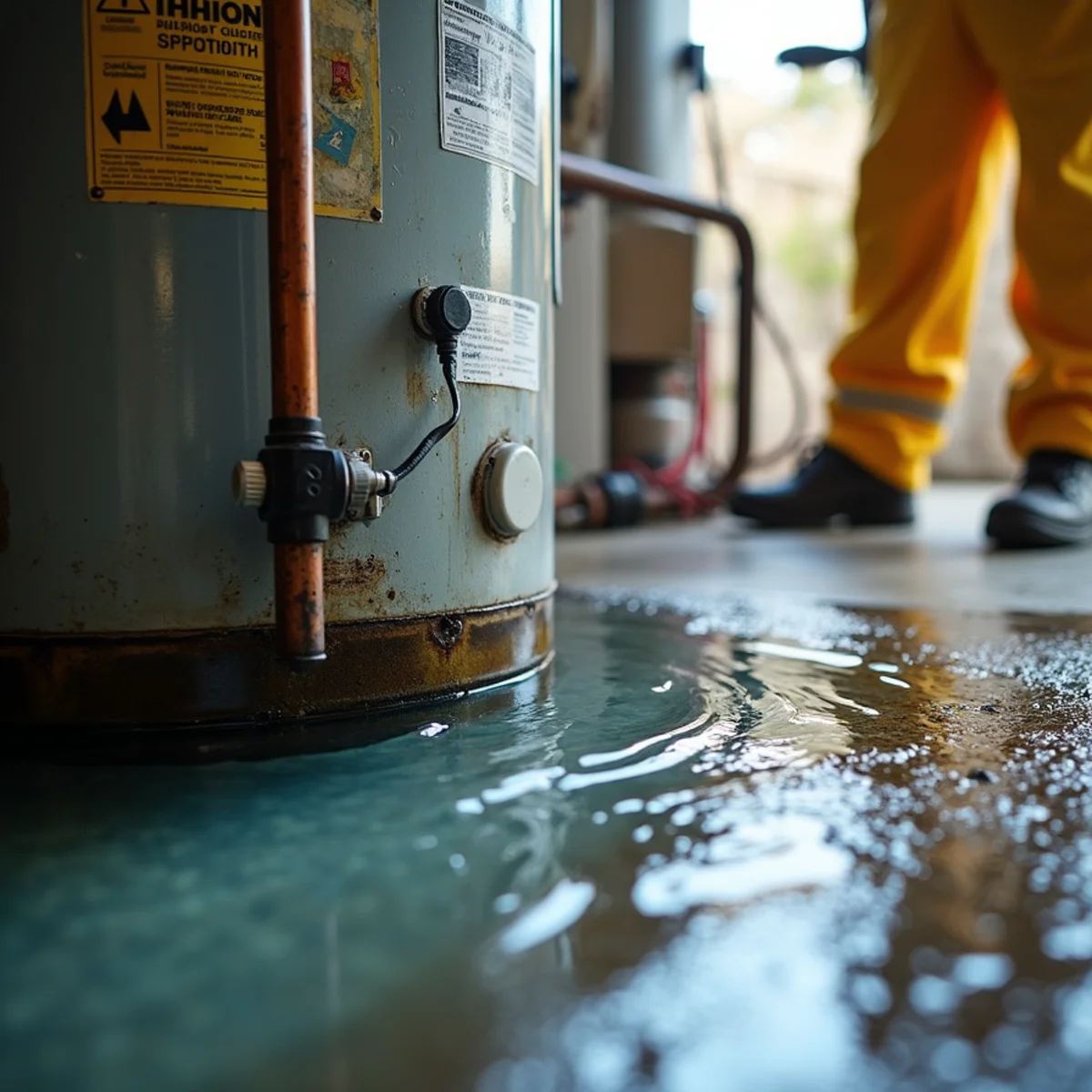
You walk into the garage and your shoes are suddenly wet. The water heater in the corner has let go, and a puddle is spreading toward the drywall, storage boxes, and whatever is stacked on the floor. A failed tank can release 40, 50, even 75 gallons in a short window, and garages rarely have a floor drain to catch it.
Here is the order of operations that limits the damage and keeps you safe, followed by what happens once we get there. Skip ahead to the steps if the water is actively spreading - read the rest after the situation is under control.
Shut off the water supply to the tank
Look for a shutoff valve on the cold water supply line feeding the top of the water heater - it is usually within a foot or two of the tank. Turn it clockwise until it stops. This is different from your home's main shutoff, and it is faster because you are not hunting for the street-side valve while water keeps spreading.
If you cannot find that valve or it will not turn, go straight to the home's main shutoff instead. Do not spend more than a minute or two searching before you fall back to the main.
Cut the power or gas - carefully
For an electric water heater, switch off the breaker labeled for the water heater at your electrical panel, and avoid the panel entirely if it is wet. For a gas water heater, turn the gas control valve on the unit itself to "off," but do not attempt anything with the gas line if you smell gas - leave the garage, get everyone out, and call your gas utility from outside before doing anything else.
California requires seismic strapping on residential water heaters under Health & Safety Code §19211. If your strapped tank has still split or corroded through, that is almost always an age-related tank failure, not a strapping problem - the fix is a plumber, and our job is the water.
Get items off the floor before the water reaches them
Garages hold cardboard boxes, off-season storage, tools, and sometimes a second refrigerator or freezer. Cardboard wicks water almost instantly and ruins its contents. Move what you can lift safely to a dry shelf or the driveway. Leave large appliances in place unless water is actively rising around them - moving a heavy wet appliance alone is a good way to get hurt.
- Cardboard boxes and paper storage first - they soak up water fastest
- Tools and anything metal, to prevent rust
- Anything electrical sitting on or near the floor
- Leave heavy appliances unless water is still rising
Call us while the water is still contained
Once the source is shut down, call +1 (201) 277-9344. Garage floods often look mild - a puddle on a slab floor - but water travels. It runs through the expansion joint, under the drywall base plate, and into an attached laundry room or interior wall faster than most homeowners expect.
We will ask when the leak started, roughly how much water is on the floor, and whether it reached drywall or an interior room. That gets the right equipment on the truck before the crew even leaves.
What we check that homeowners usually miss
Garage slabs often slope slightly toward the door for drainage, which means water finds the lowest points along baseboards and wall bottoms first - not always where the tank sits. We check moisture behind the bottom few inches of drywall around the entire garage, not just near the water heater, and we check any shared wall with an interior room.
If the garage is finished with drywall and insulation, wet insulation loses its R-value and can hold moisture against the framing for weeks if it is not pulled. We remove affected material, set containment if needed, and dry the framing itself, not just the visible surface.
We also check the door threshold between the garage and the house. Many Roseville floor plans put the laundry room or a mudroom directly off the garage, separated by only a single step and a thin weatherstrip, and that is a common spot for water to migrate into finished living space without anyone noticing until carpet or baseboard is already soaked.
Getting the tank replaced
We handle the water damage - extraction, drying, and any rebuild - and we can point you toward the next step for tank replacement, but the tank itself is a plumber's job. Most homeowners replace the water heater within a day or two of the failure, and we coordinate our drying schedule around that so the new unit does not go in on a still-wet floor.
If your water heater is original to the house and reaching 10 to 12 years old, replacing it before it fails is far cheaper than the cleanup after. Ask your plumber about the age and condition of the tank next time it is serviced, and confirm the seismic strapping required under California Health & Safety Code §19211 is still secure.
Category matters
Water heater discharge is generally Cat 1 clean water if it is caught quickly, but it degrades fast if left sitting on a warm garage floor. Faster response means less risk of mold and a shorter dry time.
What our crews watch for on a water heater call
The biggest mistake we see on water heater floods is homeowners assuming the damage stopped at the edge of the visible puddle. Garage slabs are sloped on purpose, usually toward the main door, so water from a tank in one corner can travel several feet and pool along a wall on the opposite side of the garage before anyone notices. We have opened baseboard ten feet from the tank and found it soaked, while the drywall right next to the water heater itself was untouched.
There is a real tradeoff in how fast we pull wet insulation versus giving it a chance to dry in place. Fiberglass batt insulation that has only been wet for a few hours can sometimes be dried with air movers and kept in place, saving you a repair. Insulation that has been wet for a day or more, or that was already compressed and dusty, almost always needs to come out - trying to save it just delays the inevitable while giving mold more time to establish itself in material that traps moisture against the framing. We make that call on-site based on how long the water sat and how the material tests, not on a blanket rule.
Slow leak or sudden failure - the signs before a tank actually gives way
Not every garage flood comes out of nowhere. A tank often gives warning signs for days or weeks before it fully fails, and catching those signs early is the difference between a plumber swapping the tank out on your schedule and a flood you come home to. Sediment builds up at the bottom of a tank over years, especially with Sacramento Valley's hard water, and that buildup is usually what causes the popping or rumbling sounds some homeowners notice in the months before a failure.
The distinction also matters for your insurance claim. A sudden tank rupture is generally treated differently than water damage from a slow drip that a homeowner could reasonably have noticed and addressed sooner. If you catch any of the following, do not wait for the next inspection - have a plumber look at the tank now.
- Rust-colored or metallic-tasting hot water
- Popping, rumbling, or cracking sounds from the tank as it heats
- Moisture, rust, or a chalky mineral crust around the base or fittings
- A tank older than 10 to 12 years, especially given how hard water accelerates internal wear here
- A drip pan that keeps needing to be emptied, even when the tank otherwise looks fine
Frequently asked questions
A standard residential tank holds 40 to 75 gallons, and it can empty in minutes once it splits or the tank fitting fails. Shutting off the supply valve stops the refill, which is what turns an ongoing flood into a one-time puddle.
If caught quickly it is typically Cat 1 clean water, but it can sit on a warm slab and start growing mold within 24 to 48 hours, especially if it reaches drywall or wood framing. Fast extraction and drying matters even when the water itself looks clean.
No. We can extract water and start drying with the old tank still in place or already removed. We work around your plumber's schedule and will coordinate timing so the floor is ready when the new unit goes in.
Sudden tank failures are commonly covered under homeowners policies, though gradual leaks over time sometimes are not. We document the failure and timeline clearly and bill your insurer directly for covered work.